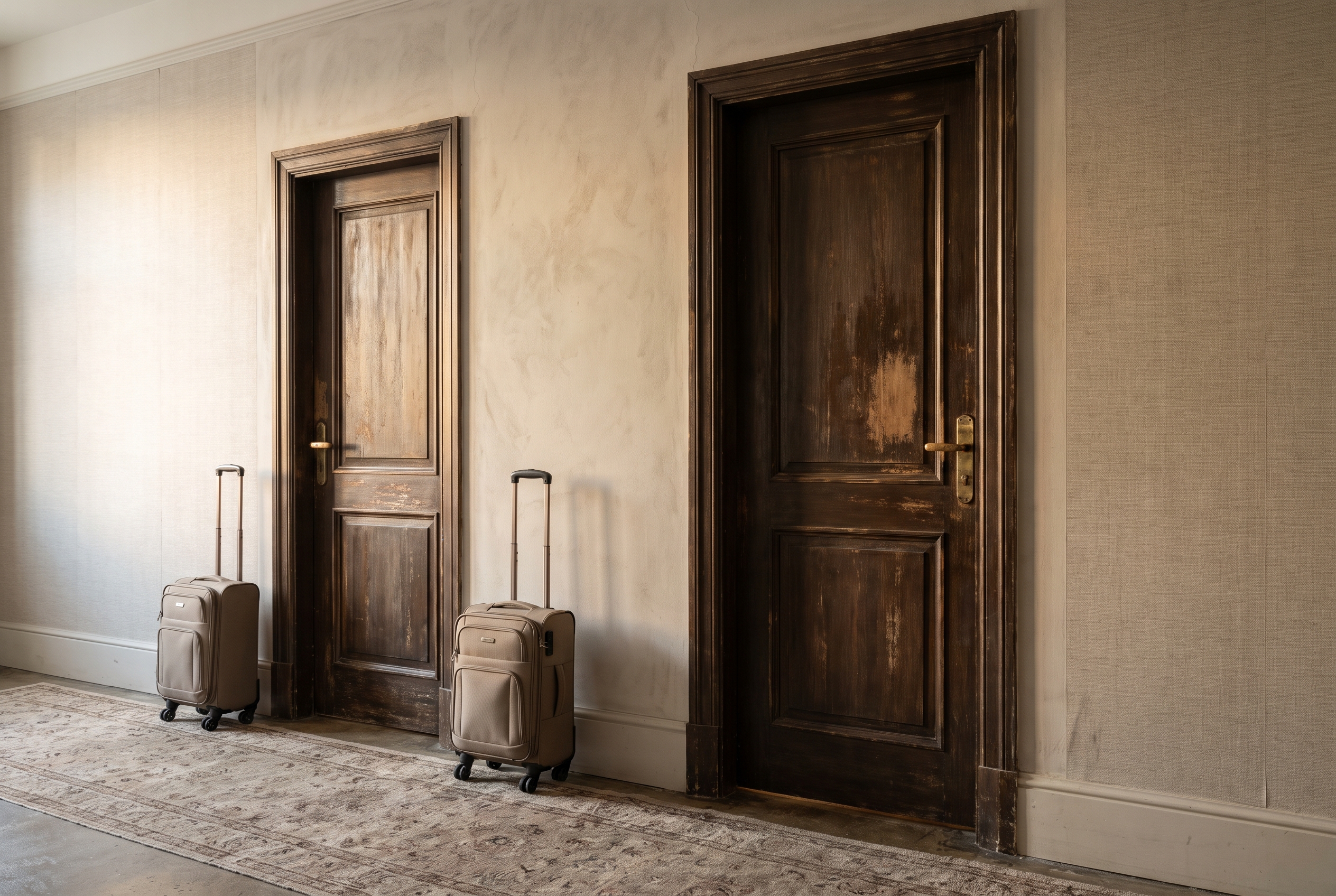

Separate Rooms or One Room: The Short Version
If this is your first trip with a travel companion, or if either of you feels even slightly hesitant about sharing, separate rooms are usually the better default. Share a room only when both people actively want the savings and the exact room setup is explicit before anyone books.
Start With the Real Question
Most people frame this as a money question. One room is cheaper than two; therefore one room must be the sensible choice. Sometimes it is. But the cost difference is only one part of the decision. The real question is what arrangement gives the trip the best chance of staying easy.
A room is not just where you sleep. It is where one person wants the lights off and the other is still on a call. It is where one person needs an hour alone after being out all day and the other wants to keep chatting. It is where somebody discovers they snore, wake at five, need silence, sleep with the air-conditioning low, or unpack across every surface they can find.
Those are not moral failings. They are just facts that become expensive when nobody mentions them until the second night.
When Separate Rooms Are the Better Default
Separate rooms make the most sense when the trip is a first test rather than a settled arrangement. If you have never travelled together before, you are still learning what the other person is like when tired, late, hot, hungry, disappointed, ill, or simply done for the day. Having your own room gives each person somewhere to reset without turning a normal low-energy evening into a referendum on the friendship.
They also make sense when one of you is not fully comfortable sharing. This should not require a defence. If one person wants their own room, that is already enough information. The goal is not to win a debate about whether the concern is rational enough. The goal is to choose the arrangement under which both people can travel well.
- this is your first trip together
- you met recently and have limited in-person time together
- your sleep habits are likely to clash
- one of you needs more privacy or downtime than the other
- one person will be drinking, dating, partying, or socialising more heavily than the other
- your arrival and departure times differ
- one person can afford more comfort and does not want that to become a negotiation three times a day
A separate room is often cheaper than the argument it prevents.
When a Shared Room Can Work Well
A shared room can work perfectly well when it is chosen deliberately rather than drifted into because it looked cheaper on a booking page. Plenty of travel companions share rooms without issue. The difference is usually not personality. It is clarity.
A shared room is much more likely to work when you already know how the other person lives at close range, or when the trip is short and tightly budgeted and both of you see the savings as genuinely worth it. It also works better when the room setup itself reduces friction: two actual beds instead of one bed nobody discussed, enough luggage space, a bathroom arrangement both people can tolerate, and a schedule that does not require one person to tiptoe around the other every morning and night.
If you do share, it should feel like a straightforward mutual choice, not a concession extracted by arithmetic. The cheaper arrangement should require two real yeses.
The Room Type Needs Saying Plainly
People are oddly indirect about rooms. They say things like "we can share accommodation" when what they mean might be a twin room, a double room, a room share, or a one-bedroom apartment with someone on a sofa bed. Those are not the same arrangement.
Say the actual thing.
- two separate rooms
- one twin room with two separate beds
- one double room with one bed
- a private apartment with separate bedrooms
- a hostel private twin room
- separate beds in a shared dorm
If you mean twin beds, say "two separate beds" instead of assuming the booking will sort itself out. If you mean separate rooms, say that as plainly too. Awkwardness before payment is cheap. Awkwardness at reception is not.
Twin vs Double vs Two Rooms
A twin room usually means one room with two separate beds. That can solve the biggest friction point for some travel companions, because nobody is sharing a mattress, blankets, or bedside space. It does not solve the whole problem. You are still sharing lights, bathroom timing, calls, alarms, and the general fact of being in one another's space from bedtime until morning.
A double room is a stronger version of room-sharing than many people admit. One bed can be fine for an established couple; for many travel companions it is simply too close. If one person says "sharing is fine" and imagines twin beds while the other has found a double, you do not have a minor mismatch. You have booked the wrong arrangement.
Two separate rooms cost more, but they buy the cleanest version of privacy. Different wake-up times matter less. Someone can shower late, work late, decompress, cry, flirt, scroll, or sleep with terrible posture without turning it into a shared experience. That is why two rooms are often the best default for a first trip.
Separate Bedrooms in an Apartment Can Be the Middle Ground
A two-bedroom apartment often works better than a standard hotel room when both people want lower costs without full-time togetherness. The key phrase is two-bedroom, not "apartment" on its own. Some apartments that look spacious in photos still put one person on a sofa bed in the living room, which brings back the same privacy problem under a nicer listing.
Separate bedrooms can be a smart compromise on longer trips. You still share an address and common area, but each person has a door they can close. That matters a lot if one of you needs more downtime, calls family at odd hours, or plans to work remotely for part of the trip.
Hostel Private Twin vs Dorm Beds
If you are looking at hostels, be just as precise. A private twin room in a hostel is still a shared room, but it is a very different experience from taking two beds in a dorm. A private twin gives you control over who is in the room, when the lights go out, and whether your bags are still exactly where you left them.
Dorm beds are not just the cheap version of a twin room. They add other variables: strangers coming in late, mixed sleep schedules, less storage, more noise, and less privacy for both companions at once. That can be absolutely fine for some trips, but it belongs in a different cost-benefit category.
Room Economics: What Are You Actually Saving?
This is where the decision gets more interesting than "one room costs less." In some destinations, the price gap between one room and two is small enough that separate rooms are an easy yes. In others, the gap is dramatic because solo occupancy triggers a single supplement or because hotel inventory is priced to reward double occupancy.
That is why it helps to compare at least three versions side by side: two separate rooms, one twin room, and a two-bedroom apartment or aparthotel. Sometimes the compromise option lands much closer to the shared-room price than people assume.
It also helps to separate whole-trip economics from specific expensive segments. Maybe the city-centre weekend is where sharing saves meaningful money, but the quieter beach leg is affordable enough for separate rooms. Maybe the long-haul gateway night can be a twin room and the rest of the trip can be separate rooms. Partial-trip compromises are often better than forcing one arrangement onto every night.
If a single supplement is what makes separate rooms feel impossible, say that plainly. That is a room-decision fact, not a personal failure. Once the real constraint is visible, you can solve for it with dates, neighbourhoods, trip length, or property type instead of pretending the only options are "share the whole time" or "cancel the trip."
If One Person Wants Separate Rooms and the Other Wants to Share
This is the part people try to finesse. Do not. If one person wants separate rooms and the other wants to share, default to the more private arrangement. The cheaper option should require an enthusiastic yes from both people, not a reluctant maybe from one.
That does not mean the person asking for privacy is accusing the other of anything. It means they are stating the setup under which they will travel best. You do not need a courtroom standard of evidence to decide how much space you want on holiday.
If the cost difference is large, there are usually compromise versions worth exploring. You can book separate rooms for the first two nights and reassess later. You can share only on the expensive leg of the trip. You can take a two-bedroom apartment rather than a one-room setup. You can choose a cheaper area, shorter stay, or slower route to protect the privacy you want.
What you should not do is share resentfully in order to save the trip budget and then spend half the trip wishing you had spent the money.
Useful Scripts for the Conversation
A lot of people do know what they want here. They just do not know how to say it without sounding cold. Plain language helps.
For separate rooms:
"I think I would travel better if we book separate rooms, especially for a first trip. I would rather spend a bit more and keep sleep and downtime simple."
For a twin room with boundaries:
"I am open to sharing a room if it is a twin, with two separate beds, and we settle the quiet-hours and cost split before we book."
For the cautious version:
"Could we do separate rooms for the first couple of nights and then decide whether sharing later in the trip still feels sensible?"
For budget pressure without guilt-tripping:
"I can do this trip if we keep accommodation costs down, so I wanted to ask whether a twin room is something you would actually be comfortable with. No pressure if not."
Those sentences are ordinary. That is the point. You are not announcing a crisis. You are sorting the mechanics before they become one.
What This Decision Is Really About
On the surface, this is about accommodation. Underneath, it is about boundaries and expectations. The room question forces two people to reveal how much privacy they need, what level of closeness they assume, what they think counts as reasonable saving, and how directly they can talk about discomfort.
That makes it a useful question. If you cannot have this conversation clearly before the trip, that tells you something valuable about whether the larger trip is ready.
A good answer does not have to be the same on every trip. The right choice might be separate rooms with one person you barely know, a twin room with someone you have travelled with before, and separate bedrooms in an apartment on a longer route where both of you need downtime. The point is not to follow a universal rule. The point is to pick the arrangement that fits the actual trip and the actual people.
If you need the broader conversation next, use something more specific. For the full pre-booking checklist, read what to agree before you book a trip together. For extra caution on a first trip with someone you met on the internet, read how to travel more safely with someone you met online. If the sticking point becomes money after you choose the room setup, read how to split trip costs without resentment. If you are still deciding whether VoyageVixen is the right place to find or vet a companion before this conversation even starts, see how VoyageVixen works or join the community. This page is only here to help you choose the room arrangement itself.
The Best Room Decision Makes the Rest of the Trip Easier
That is the standard worth using. Not whether one option sounds more trusting, more relaxed, or more adventurous. Whether it makes the rest of the trip easier.
If separate rooms make both of you calmer, book separate rooms. If a shared room saves meaningful money and both of you are genuinely comfortable with the details, share the room. If you are not sure, buy flexibility rather than optimism.
The room is only one line on the itinerary, but it has a way of deciding the mood of everything around it. Settle it clearly, in plain words, before anyone pays, and the trip has a much better chance of feeling simple for the right reasons.